AI Agents in Business Automation — How Autonomous AI Is Transforming Business Operations
Introduction
Businesses are moving beyond simple automation toward systems that can understand information, plan tasks, use digital tools, and help complete multi-step processes.
Traditional automation is useful for repetitive activities that follow predefined rules. However, many business tasks require more flexibility. An incoming customer request might need to be understood, categorized, checked against company information, and directed to the correct department.
This is where AI agents are becoming increasingly relevant.
AI agents can use artificial intelligence to interpret goals, gather information, select appropriate actions, and work through defined tasks. When connected to business applications and automation workflows, they can help organizations streamline operations and reduce repetitive work.
For businesses exploring digital transformation, understanding AI agents is an important step toward building more intelligent business processes.
What Are AI Agents?
AI agents are software systems designed to work toward a defined objective by interpreting information and taking appropriate actions within their permitted environment.
Depending on their design, they may use large language models, business rules, external tools, APIs, company knowledge bases, and workflow systems.
For example, an AI agent supporting a sales team might review an incoming enquiry, identify the customer's requirements, retrieve relevant service information, prepare a response draft, and recommend the next step.
Some agents can execute approved actions directly, while others require human approval before making changes or communicating externally.
The level of autonomy depends on the system's design, permissions, reliability, and risk controls.
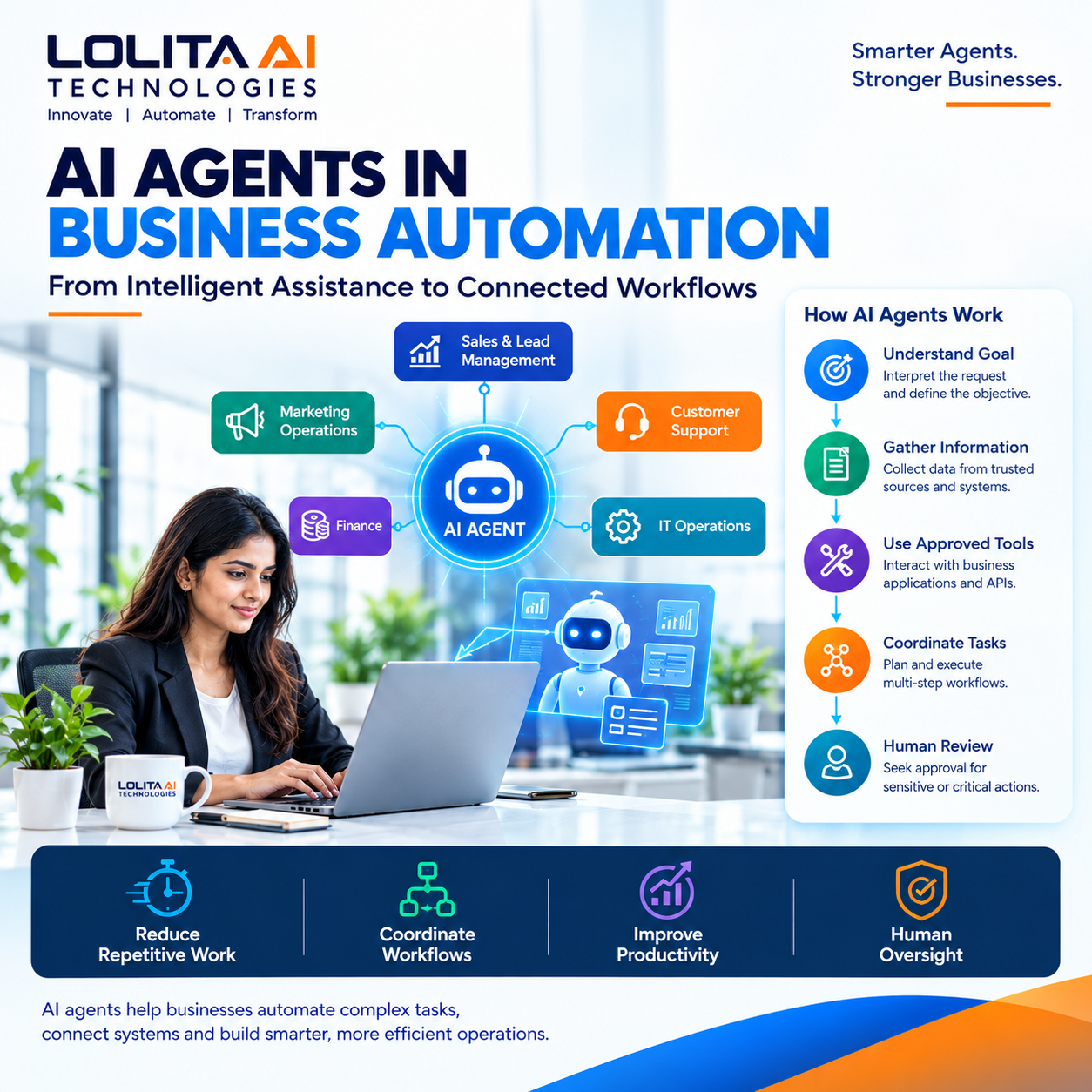
How Do AI Agents Work?
AI agents generally combine several capabilities.
Understanding the objective
The agent receives a goal, such as organizing incoming customer enquiries or preparing a summary of sales opportunities.
Gathering information
It retrieves relevant information from approved documents, databases, applications, or other available sources.
Reasoning and planning
The agent determines the steps needed to address the request. Complex tasks may be divided into smaller activities.
Using tools
Depending on its permissions, the agent may interact with a CRM, retrieve records, call an API, prepare a document, or trigger an existing workflow.
Reviewing results
The agent checks whether the task has been completed or whether additional information or human assistance is required.
Human oversight
For sensitive or consequential actions, the system can request approval before proceeding.
These capabilities allow AI agents to support processes that involve more than a single predefined action.
AI Agents vs Traditional Automation
Traditional automation follows predefined instructions. For example, when a customer submits a form, an automation workflow can send a confirmation email and store the submission in a CRM.
An AI-powered workflow may additionally analyze the message, identify the customer's intent, classify the enquiry, and recommend the appropriate response.
An AI agent can go further by planning and coordinating multiple permitted steps toward a defined objective, using available tools and checking results along the way.
These approaches are complementary rather than interchangeable.
Traditional automation remains effective for predictable, rule-based processes. AI agents are useful when tasks involve varied information, multiple steps, or decisions that benefit from AI assistance.
The best solution may combine both.
Key Benefits of AI Agents in Business Automation
Reduced repetitive work
AI agents can assist with tasks such as gathering information, summarizing documents, categorizing enquiries, and preparing reports. This can reduce the manual effort required for routine activities.
Faster information processing
Agents can retrieve and organize relevant information from approved sources, helping employees spend less time searching through documents and applications.
Improved workflow coordination
When connected to business systems, agents can help coordinate several stages of a process instead of handling each activity in isolation.
Better employee productivity
Employees can use AI agents to prepare first drafts, analyze information, summarize meetings, and organize tasks, while retaining responsibility for important decisions.
More responsive customer service
AI agents can help classify customer questions, retrieve approved information, draft responses, and route complex cases to human support teams.
Scalable operations
Well-designed agent systems can support increasing volumes of requests, provided that infrastructure, costs, accuracy, and oversight are managed appropriately.
Common Business Use Cases of AI Agents
Sales and lead management
An AI agent can review incoming enquiries, summarize customer needs, organize available company information, and recommend a suitable follow-up.
For example, when a business receives a request about workflow automation, an agent could identify the main requirement and prepare a summary for the sales team. Qualification criteria and final sales decisions should remain under appropriate human oversight.
Marketing operations
AI agents can help research topics, organize content ideas, analyze campaign reports, summarize audience feedback, and prepare draft marketing materials.
Marketing teams should review generated content for accuracy, brand consistency, and compliance before publication.
Customer support
An agent can identify the intent of a customer question, search an approved knowledge base, and prepare an answer based on available information.
Requests involving complaints, sensitive information, or unusual situations can be escalated to a human representative.
Finance and administration
AI agents can assist with document summaries, expense categorization, invoice information checks, and report preparation.
Financial approvals, payments, and other high-impact actions should use appropriate validation and authorization controls.
Human resources
Agents can help organize onboarding information, answer routine policy questions using approved documents, and prepare administrative summaries.
Sensitive employment decisions should not be delegated to an AI agent without appropriate human judgment and safeguards.
IT and internal operations
AI agents can assist with troubleshooting guidance, knowledge retrieval, ticket categorization, and incident summaries. Actions that affect production systems should require suitable access controls and approval.
AI Agents and Workflow Automation
AI agents become particularly useful when integrated with workflow automation.
Workflow automation defines how information and tasks move between systems. An AI agent can interpret information or recommend what should happen at particular stages.
Consider a business receiving a new service enquiry.
The website captures the enquiry.
An AI agent identifies the customer's main requirement.
The system checks the information against approved qualification criteria.
The enquiry is recorded in the CRM.
A workflow assigns it to the appropriate team.
The sales team receives a notification.
A response is prepared for review or sent automatically if the action is authorized and appropriate.
This combination can reduce manual coordination while keeping the business process structured and measurable.
AI Agents vs RPA
Robotic Process Automation, or RPA, is designed to automate repetitive, rule-based tasks across applications.
AI agents focus on interpreting objectives, working with information, and coordinating permitted actions.
For example, RPA may transfer invoice details between systems according to predefined rules. An AI agent may help interpret a document, identify missing information, and determine which review workflow should be triggered.
In a combined solution, AI can support document interpretation while RPA or conventional automation performs predictable system interactions.
The appropriate choice depends on the task, reliability requirements, system integrations, and cost.
Challenges and Risks of AI Agents
AI agents can produce incorrect results, misunderstand instructions, or select inappropriate actions. Access to tools and business data also introduces security and privacy considerations.
Businesses should address these risks before deployment.
Data security and access permissions
Agents should access only the information and systems necessary for their assigned tasks.
Accuracy and verification
Important information should be checked against reliable sources, especially when the output affects customers, finances, or business decisions.
Human approval
Sensitive actions such as payments, contractual commitments, account changes, and external communications may require explicit human approval.
Monitoring and accountability
Organizations should track performance, record important actions, define ownership, and provide a way to stop or reverse actions where possible.
Cost and integration
AI usage, application integrations, maintenance, and testing can add costs. Businesses should evaluate the full process rather than focusing only on the AI model.
How Businesses Can Start Using AI Agents
Businesses do not need to automate every department at once.
First, identify a repetitive business process that has a clear objective and measurable outcome.
Next, document how the process currently works, including the systems involved, common exceptions, manual effort, and risks.
Choose a limited use case, such as classifying incoming enquiries or summarizing internal documents.
Determine which information the agent may access and which actions it may perform. Begin with read-only access or draft-only outputs when appropriate.
Test the solution using realistic examples, including unusual inputs and failure scenarios.
Measure performance against the existing process. Useful measures include processing time, accuracy, manual effort, error rates, and cost per completed task.
Expand the system only when results are reliable and the necessary controls are in place.
The Future of AI Agents in Business
AI agents are developing from simple assistants into systems that can coordinate increasingly complex tasks across business applications.
Future implementations are likely to combine AI agents with workflow automation, RPA, enterprise data, analytics, and specialized business software.
However, greater autonomy does not automatically mean better performance. Reliable business adoption will depend on clear objectives, dependable information, suitable integrations, controlled permissions, and effective human oversight.
Organizations that focus on practical business problems rather than adopting AI simply because it is new will be better positioned to identify meaningful opportunities.
How Lolita AI Technologies Can Help
Lolita AI Technologies provides AI, automation, and custom software capabilities that can help businesses explore intelligent digital workflows.
Depending on a company's requirements, an AI-enabled solution may support information processing, workflow coordination, repetitive task automation, business application integration, and custom software development.
A practical implementation begins with understanding the business process, identifying the appropriate automation opportunities, selecting suitable technologies, and defining measurable outcomes.
AI agents should be designed around real business needs, with appropriate security, testing, and human oversight.
Conclusion
AI agents are expanding the possibilities of business automation by helping systems interpret information, plan tasks, use approved tools, and coordinate multi-step processes.
From sales and marketing to customer support, administration, finance, and IT operations, they can reduce repetitive work and support employee productivity.
Successful implementation requires more than choosing an AI tool. Businesses need clear objectives, reliable data, suitable integrations, appropriate permissions, and ongoing monitoring.
By combining AI agents with traditional automation and human expertise, organizations can build business processes that are more intelligent, connected, and efficient.
Frequently Asked Questions
What is an AI agent in business?
An AI agent is a software system that works toward a defined objective by interpreting information and taking permitted actions using available tools and systems.
How are AI agents different from chatbots?
A conventional chatbot primarily responds to user messages. An AI agent may also plan tasks, retrieve information, use connected tools, and coordinate multiple steps toward an objective. Some chatbots also include agent capabilities.
Can AI agents automate business processes?
Yes. When connected to suitable applications and workflows, AI agents can assist with activities such as classifying enquiries, retrieving information, preparing summaries, and coordinating approved actions.
Are AI agents the same as RPA?
No. RPA primarily automates repetitive, rule-based interactions, while AI agents can interpret information and coordinate tasks toward a goal. The technologies can work together.
Are AI agents suitable for small businesses?
Yes. Small businesses can start with a limited, well-defined use case, such as enquiry classification or internal knowledge retrieval, and expand based on measured results.
What risks should businesses consider?
Important risks include inaccurate outputs, data privacy, unauthorized actions, security vulnerabilities, integration costs, and inadequate monitoring.
Do AI agents replace employees?
AI agents can automate or assist with specific tasks, but human judgment, accountability, relationship management, and oversight remain important, especially for consequential decisions.
How can a company get started with AI agents?
Start by identifying a measurable business problem, mapping the existing process, selecting a low-risk use case, defining permissions, testing performance, and monitoring results.
Looking to make your business processes smarter and more efficient?
Explore AI, workflow automation, and custom software solutions with Lolita AI Technologies to identify practical opportunities for your organization.